New releases by Interpol, Phoebe Bridgers, Lambchop


 Latest editorial

‘I believe Mike wanted high emotion in his work’
Chris Searle speaks to former bandmate CHRIS BISCOE about the committed socialist jazzman, Mike Westbrook
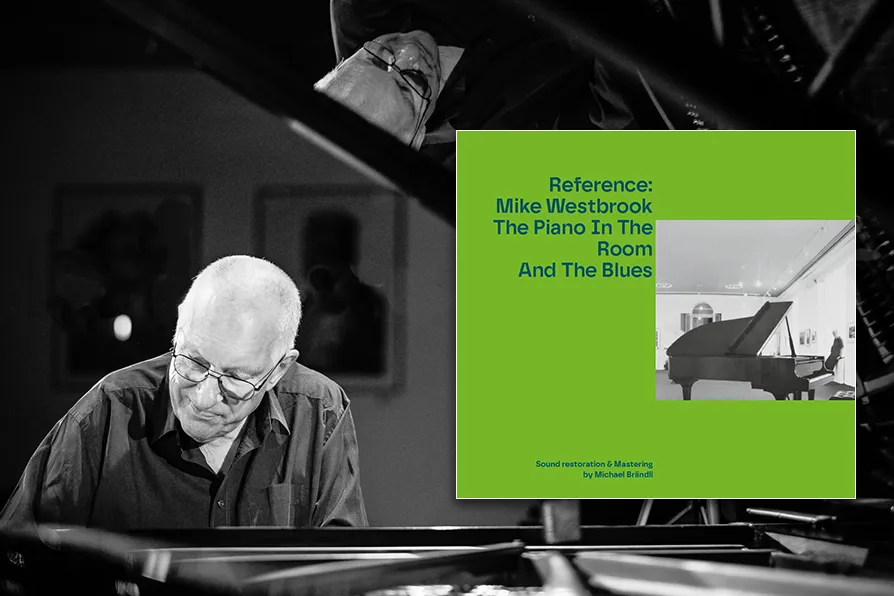 TROUBADOUR OF FREEDOM: Mike Westbrook [Pic: Laurent Poiget/Flickr]
ANGUS REID urges us to understand the persecution of Jason Arday from a political and historical perspective, and to see the victim in human terms
Re-releases of the classics Gypsy Rhumba and Buena Vista Social Club, and a stunning album by Palestinian artist Faris Ishaq
Nothing, says ANDY HEDGECOCK, can rescue this undistinguished amalgam of ponderous melodrama and shallow philosophical speculation
JAMIE BRITTON invites readers to visit 3,500 locals as part of a marathon artistic pub crawl
JOHN GREEN welcomes a valuable and incisive analysis of a world become hyperpolitical but without the mass movement institutions to represent it





THE last time that I heard the late Mike Westbrook play piano was in September 2023 when he played a duet with his long-time alto saxophone confrere, Chris Biscoe. The event was a tribute at Cafe Oto to two pioneering British jazz labels Cadillac and Ogun, and Westbrook announced that their improvisation was a blues in remembrance to Cadillac’s founder, John Jack, for whom he recorded in the late ’60s and early ’70s. It was a deeply moving piece, full of love and gratitude.
So when I heard that the new Westbrook solo piano album, recorded in 2006, The Piano In The Room And The Blues, was being released, I knew that I needed to talk to Biscoe about Mike’s piano musicianship. Their union goes back to 1979, when Biscoe first played in the Westbrook Brass Band in Salzburg, and the first concert recording of one of Westbrook’s great orchestral suites, The Cortege, in 1980.
I ask him about Westbrook’s love of the blues. On this record he plays variations of Bessie Smith’s Young Woman’s Blues and Good Old Wagon, and Chicago bluesman Jimmy Yancey’s Death Letter Blues, which inspired his own Carillon Blues, dedicated to Italian trombonist Danilo Terenzi, a bandmate whose early death at 39 from cancer profoundly shocked his entire orchestra.
“Mike had a particular affinity with Jimmy Yancey. He loved the old blues forms — the blues for Terenzi is an eight-bar traditional form. Sometimes he played the time in the traditional sense, other times it was as if the time was unstated and he played only the comments and embellishments. These are often very plangent, although the overall approach is not physically very demonstrative.”
Westbrook, like his hero Ellington, had a huge musical intellect, but like the Duke too, he was a very emotive musician. The feelings pour out of his piano on the album’s four versions of Carillon Blues as he remembers Terenzi, as they do in the Ellington album in memory of the Duke’s great composing partner, Billy Strayhorn, And His Mother Called Him Bill.
“I believe Mike wanted high emotion in his work,” said Biscoe. “It’s there in the love songs that he wrote and his works demonstrating a clear political motive.”
It’s there too, most movingly, in his duets with his wife Kate, which so often became a trio with Biscoe’s saxophone. Kate’s voice united in great beauty and meaning with the elegiac lyricism of his piano. Their 1991 album Goodbye Peter Lorre has the evocative simplicity of the song Wasteground and Weeds, describing the couple’s walks through east London.
Kate sings: “City Sunday/ With/ Pavements bare/ Shops all shuttered/ Who cares!/ Walking from Poplar/ Round Bunhill Fields/ Back past St Paul’s/ Past/ Wasteground and weeds…/ Flocks of sparrows, banks of dog-rose/ In the bombsite knotgrass grows/ Mattress-ticking, lorry tyres/ Cold ash left by wasteground fires/ Bindweed climbs on salty walls/ Our journey onward crawls.”
All through the song, Mike’s piano is another moving voice, fusing with Kate’s words.
I asked Biscoe how Westbrook saw his own pianism. Ellington always referred to himself simply and modestly as “the piano player.” Westbrook too kept his piano away from solo prominence when playing with the orchestra.
“I think he liked to see himself as ‘the piano player in the band.’ He was particularly fond of setting the scene, whether it be extended introductions to trio pieces, or playing several choruses at the start of a band piece. This wouldn’t be a ‘solo’ but, as in the start of On Duke’s Birthday, a build-up and preparation for the band to enter. I don’t think I ever heard him play a solo in the middle of a piece.”
But this new album tells another story. He is alone with his keys, but there is no solitariness. Solo virtuosity, emotional depth, imaginative empathy with all humanity all ring out in a record of unique musicianship from a man whose strength of sound pealed through the second half of the 20th century in so many forms, from Blake’s minstrel and the people’s brass bandleader to a true orchestral troubadour of freedom.
This album gives yet another expression of his protean genius.
The Mike Westbrook solo piano album The Piano In The Room And The Blues is released by Thingamajig Records.
