


Afcon performances suggest a team far stronger than qualifying results showed, JAMES NALTON discusses
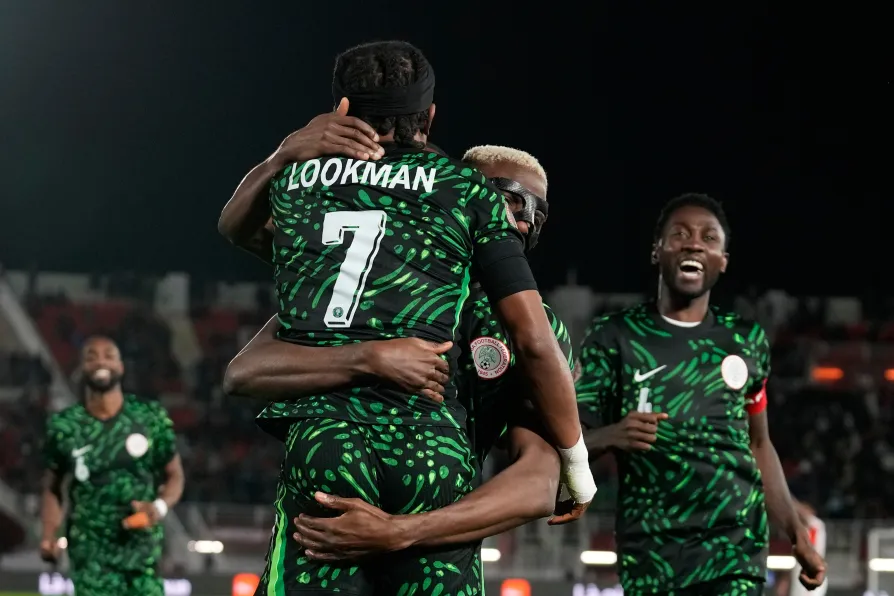
 Nigeria's Victor Osimhen (centre) celebrates with Nigeria's Ademola Lookman (front) after scoring his side's third goal during the Africa Cup of Nations round of 16 soccer match between Nigeria and Mozambique in Fez, Morocco, January 5, 2026






WATCHING Nigeria at this African Cup of Nations (Afcon), it’s difficult to believe that the Super Eagles have somehow failed to qualify for the upcoming World Cup.
They are Afcon’s top scorers with 12 so far, scoring multiple goals in each of their games, and putting four past Mozambique in the first knockout round.
They count two of the continent’s standout attacking players, Ademola Lookman and Victor Osimhen, among their ranks, who each have three goals at the tournament, one off the leading scorer, Brahim Diaz of Morocco.
Lookman’s four assists to go with his goals make him the best performer in Morocco so far, edging him ahead of numerous other impressive players, including Diaz, Sadio Mane, and Amad Diallo.
With Africa getting nine spots at the newly expanded World Cup, it seemed almost certain that Nigeria would be among them.
But a combination of poor results against Lesotho, Zimbabwe, and Benin, missing Osimhen for several games through injury, and a failure to defeat a much-improved South Africa team that eventually topped the group, left them needing a win in a second-round playoff against DR Congo for a chance in the inter-continental playoffs.
They didn’t get that chance, as the unconvincing performances from the group stage of qualifying returned, Osimhen went off injured, and DR Congo managed to take the game to penalties and win from the spot.
There is a worry that the inconsistent World Cup qualifying version of Nigeria could return in these key moments at Afcon, but knocking out Algeria would be a tough task even for a team in form.
The more positive feel around Nigeria at Afcon, in comparison to those World Cup qualifiers, has been thanks to a few factors, including the increased availability of Osimhen, gradually improved performances under manager Eric Chelle (appointed this time last year), and the introduction of 25-year-old Sevilla striker Akor Adams.
Adams has been key to Nigeria’s improved attacking output, facilitating the play of the star names around him and emerging as a star in his own right as a result.
At 6-foot-3, he has borne the physical brunt of the opposition defences, holding up the play when needed, occupying defenders, and making intelligent runs off the ball to create space and chances for others.
If there’s a Nigeria goal celebration going on, Adams is usually in the vicinity, having played some part, either directly with assists, as he did in the 4-0 win against Mozambique, or through his presence in the opposition area.
This is Adams’s first Afcon, having only made his Nigeria debut in World Cup qualifying in October. Since he came into the Nigeria team, they have emerged victorious in seven of the eight matches in which he has featured. The only defeat for Adams, and indeed Chelle, came in that penalty shootout against DR Congo (Adams scored his spot kick).
It’s easy to say in hindsight, but had Adams been present throughout the World Cup qualifiers, it might have been a different outcome.
Add the creativity of Alex Iwobi behind the trio of Adams, Lookman, and Osimhen, and you have an attacking combination that is unstoppable on its day.
This will still be a tough game for Nigeria, as the quarterfinal lineup at this Afcon is tough for all involved, featuring as it does the eight highest-seeded teams at the start of the tournament.
The nature of the group stage and last 16, which offered some entertaining football but few shock results, meant the teams that were expected to progress to the quarters did so.
And though Nigeria’s results and performances have been impressive, there have still been a few unnecessary hiccups along the way.
A confrontation between Osimhen and Lookman in the Mozambique game, after the latter didn’t pass when the former thought he should have, distracted from some of the more positive headlines, while there has also been an issue with unpaid bonuses from these early wins.
There were murmurs that the team would not travel to train in Marrakesh to face Algeria unless bonuses were paid.
African sports writer Oluwashina Okeleji reported that captain Wilfred Ndidi had offered to pay these bonuses himself in order to minimise disruption in the camp, while the Nigerian FA has since told ESPN that the payments are being processed and merely facing delays due to international bank transfer issues.
In the end, the players did catch their Thursday flight to Marrakesh, where they will play Algeria at the stadium to the north of the city, beyond the Tensift River and the historic Tensift Bridge.
Like many of these quarterfinal matchups, it wouldn’t look out of place as a final, and the two have met twice in Afcon finals, both in home tournaments. Nigeria defeated Algeria 3-0 in Lagos in 1980, and Algeria got revenge with a 1-0 win in Algiers in 1990.
As well as the attacking talents of former Manchester City winger Riyad Mahrez, Algeria also boast one of the best-performing goalkeepers at the tournament so far in Luca Zidane, son of Zinedine Zidane.
The goalkeeper will certainly have his work cut out against Nigeria, who’ll be hoping their attacking combinations can propel them to the final for the second Afcon in a row, and a first final win since 2013. It might not completely make up for missing out on the World Cup, but it would ease some of the pain.
