Preferable to Starmer he may be, but there is scant sign of a sharp political break in Burnham’s policies so far — while left challenges aren’t making much of a running either, finds ANDREW MURRAY. How can socialism be put back on the map?


 Latest editorial

Bolivia: The Constitution of the Plurinational State at Stake
Bolivia’s protests are a response to Rodrigo Paz’s attempt to privatise core sectors of the economy and unravel two decades of socialist progress, say WIPHALAS ACROSS THE WORLD
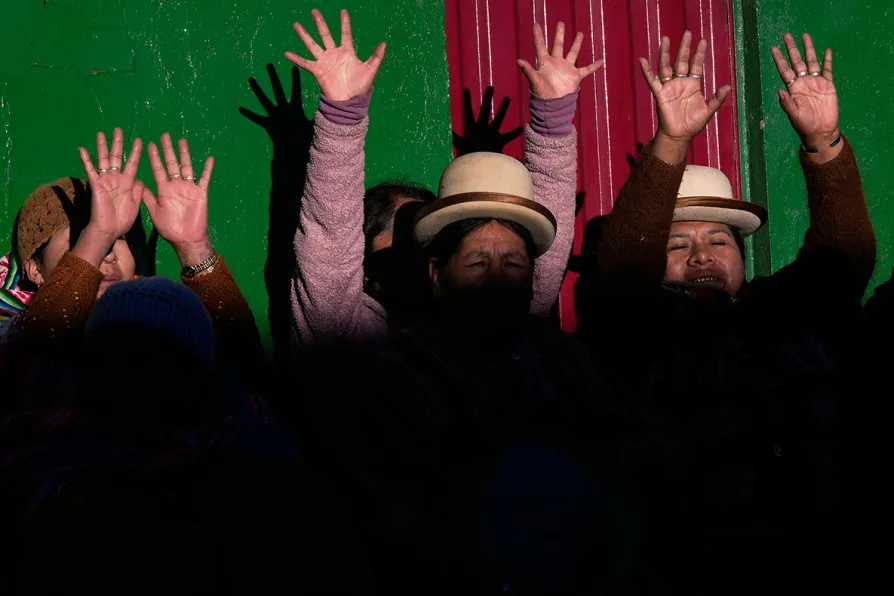 Aymara Indigenous people raise their hands to receive the first rays of sunlight during celebrations of the Andean New Year, which marks the Southern Hemisphere's winter solstice, in El Alto, Bolivia, June 21, 2026

CHARLEY ALLAN reports from Clacton on Farage’s fears his by-election stunt has backfired
JEREMY CORBYN says we should never forget the horrific reality of nuclear weapons, or cease our efforts to rid the planet of them entirely
The new TUC Cymru general secretary speaks to Morning Star Wales reporter David Nicholson about her trade union background and ambitions for the movement
Internationalism is deeply embedded in socialist theory and practice. Examination illuminates its complexity asserts the Marx Memorial Library and Workers’ School
The Claudia Sheinbaum government is no pushover and is holding firm despite US abuses of the relationship, says DAVID RABY
As we approach the grim anniversaries of Hiroshima and Nagasaki, SIMON BARROW sounds the alarm over the dangerous and murderous direction our government is heading





DURING the electoral campaign that elected Rodrigo Paz as President of the Plurinational State of Bolivia, he presented himself as a moderate alternative to his far-right opponent, Tuto Quiroga, as well as to the two other right-wing candidates (Samuel Doria and Manfred Reyes Villa).
However, no sooner had he been sworn in than Paz promoted and implemented a series of aggressive neoliberal policies which, among other things, include privatisations, drastic cuts to state subsidies, harsh austerity measures, and structural reforms to strategic sectors of the national economy.
One of the most controversial proposals of the Paz government is to undermine land ownership rights, which would affect many indigenous and peasant communities that, moreover, produce the majority of the country’s food. Such a “change” would allow collective land ownership to be used as collateral in financial transactions, thereby exposing it to eventual privatisation and acquisition by powerful domestic and foreign landowning conglomerates.
Virtually all of these measures contradict both the letter and spirit of the principles enshrined in the Constitution of the Plurinational State of Bolivia.
Paz’s measures have exacerbated inflation by increasing the prices of fuel, transport, food and basic necessities, eroding the purchasing power of millions of citizens and severely damaging the wellbeing of wide-ranging sectors: peasants, workers, teachers, transport workers, small traders and the poor in general.
The popular response was not long in coming: a national protest and roadblocks have paralysed the country for more than 50 days to date, demanding President Paz’s resignation.
Paz’s electioneering “moderation” — presented as a departure from the “statist” model of the MAS (Movement Towards Socialism) governments that ruled from 2006 to 2026 — concealed his true neoliberal intentions.
Tuto Quiroga was more honest in proposing a “radical reform” of the constitution to abolish all aspects of national sovereignty (energy resources), the distribution of property (agrarian reform) and the welfare of the population (constitutionally enshrined social benefits).
Thus, what is at stake in the national protests against Rodrigo Paz’s measures — which enjoy the solid support of all the right-wing factions of Quiroga, Doria and Reyes Villa, as well as the Trump administration — is the privatisation of the country’s natural resources, from hydrocarbons and lithium to mining, and the abolition of the social, political and cultural achievements of the Constitution of the Plurinational State.
The defence of public ownership over natural and strategic resources, nationalised during two decades of MAS governments, has become a central point of the protests against Paz.
Social resistance to the aggressive neo-liberalisation of the national economy has led the Paz government to brutal levels of police and military repression, with the support of paramilitary groups (already resulting in seven deaths), which recall the grim days of the Jeanine Anez dictatorship.
Today, Rodrigo Paz has declared a State of Exception due to Internal Upheaval, meaning that fundamental rights are suspended.
This includes extraordinary measures in situations of internal unrest and grants the armed forces special powers to act jointly with the national police to control and restore public order, seeking to silence protesters through the use of lethal weapons and further persecution.
The measure suspends, among other constitutional rights, freedom of movement and assembly, the compulsory immobilisation of persons, the prohibition of mass gatherings and public demonstrations, and the prevention of any form of blocking.
In short, the implementation of the neoliberal agenda in Bolivia requires the drastic restriction of democratic rights and the crushing of the resistance of the Bolivian people.
The movement of social resistance to the neoliberal assault of Rodrigo Paz’s government is the main obstacle facing the Bolivian oligarchy and Yankee imperialism in their bid to dismantle the Constitution of the Plurinational State of Bolivia, and thereby implement their anti-worker, anti-peasant, anti-people, anti-indigenous and, above all, anti-national programme.
We express our full support for the peasant, indigenous, worker and popular resistance against the neoliberal assault of the Paz government on the social, economic, political and cultural achievements of the people of Bolivia, as well as its attempts to reverse agrarian reform and privatise the nation’s natural resources.
No to Rodrigo Paz’s privatising neoliberal agenda!
No to the regression of the rights of Bolivia’s indigenous populations!
No to the repression of the legitimate right to social protest in defence of the social achievements and national sovereignty enshrined in the constitution!
No to the systematic violation of the human rights of the fighting people!
No to the State of Exception!
Long live the Plurinational State of Bolivia!
Wiphalas Across the World is the progressive and revolutionary unitary response of Bolivian residents abroad to the racist-fascist coup d’etat, perpetrated by the US-UK imperialist alliance, the European Parliament and the OAS.
