
JAMES NALTON argues that Curtis Jones’s departure leaves Liverpool facing a stark local void as the club’s roots are increasingly swallowed by football’s globalised model



When Jewish pride found a home in the boxing ring
As antisemitism spread across Europe and the United States in the 1920s and 1930s, Benny Leonard and Jack ‘Kid’ Berg became symbols of hope and resilience, writes JOHN WIGHT
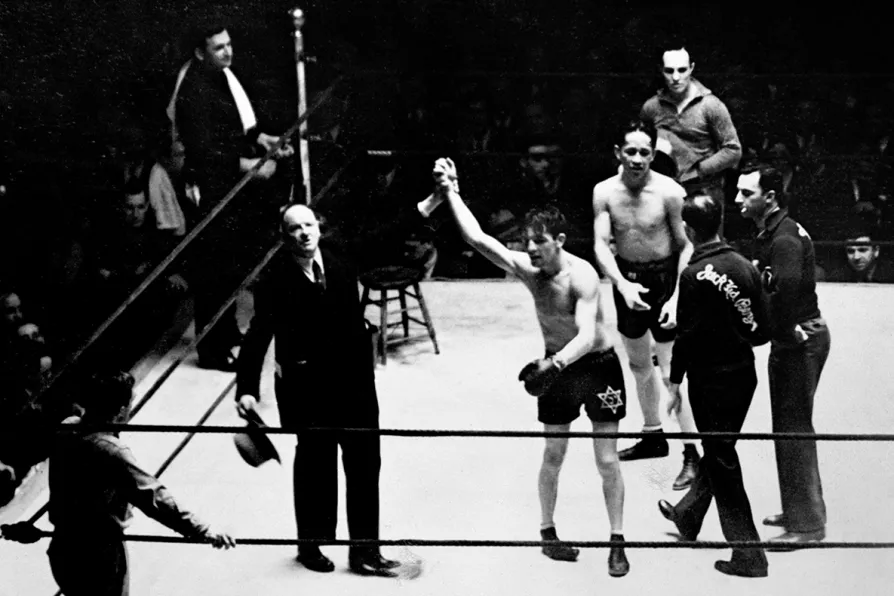
 Announcer Joe Humphries raises the hand of British boxer Jack ‘Kid’ Berg, aka ’The Whitechapel Whirlwind,’ who beat US boxer Tony Herrera, aka ‘The Symphony in Leather,’ at Madison Square Gardens May 1931





THE 1920s and 1930s were decades of seismic importance in Jewish affairs. During the former, antisemitism had begun to rear its malign head within the context of a capitalist system still recovering from the ravages of the first world war, while during the latter it would go on to reveal the very worst of the human condition.
In the early 1920s, Jewish immigrants to Britain and the US were the subject of the same moral panic that had surrounded them since the late 19th century. In the salons of the well-to-do in London and New York, this wave of desperate humanity arriving in their midst, mostly from eastern Europe, represented an invasion to be resisted in the name of national purity, rather than the opportunity to establish bonds of solidarity in the name of common humanity.
“Unhappy the land that is in need of heroes,” the estimable German communist and playwright Bertolt Brecht argues through one of his characters in his 1938 play, The Life of Galileo. For those Jews living in poverty in London’s East End and New York’s Lower East Side in the 1920s, heroes were never more necessary and also in short supply.
This is where Benny Leonard and Jack “Kid” Berg step into the picture.
When both were in their pomp as two of the finest lightweight fighters to ever do it, they wore the Star of David on their shorts with a mixture of defiance and pride. The result was the myth of the weak and helpless Jew being shattered each and every time they stepped into a boxing ring.
Leonard, born Benjamin Leiner in 1896, grew up in the aforementioned Lower East Side of New York’s Manhattan. To be a Jewish kid in that part of the world at that time was to be forced to make the choice between either fight or flight. Leonard chose to fight.
This he did on a near daily basis with the sons of other immigrant groups — Italians, Irish, Poles, Russians, etc — within the racialised crucible that defined working-class life in New York at this point in the city’s social history. The salient lesson he took from the experience was that the punches you don’t throw, bruise on the inside.
Jack “Kid” Berg, born Judah Bergman in 1909, was the son of a Jewish immigrant family originally from Odessa in tsarist Russia. London’s Whitechapel in the city’s iconic East End was his stomping ground, and it was there, growing up, that he was compelled to engage in his fair share of stomping.
Benny Leonard and Jack “Kid” Berg were classic cases of being products of their environment. It is one which dictated for young men such as they, fighting was necessary not only for physical but also spiritual survival. The ring is where they were afforded the opportunity to do so legally and with monetary reward in mind.
Benny Leonard soon established a devoted fan base in New York. Through him, Leonard’s predominantly Jewish fans were afforded the opportunity to experience the kind of cultural and religious pride otherwise denied to them. His professional boxing career lasted from 1911 all the way up until 1932. Over that prolonged span, he fought a remarkable 219 times, of which he won 70, lost 22, and had nine draws. He held the world lightweight title between 1917 and 1925, making him one of the longest-reigning world champions in the history of the sport.
1925 was meant to be Leonard’s last in the squared circle. It saw him retire as so few champions do, while still at the top and financially secure. But then came the stock market crash of 1929 to upend the lives of millions, including him, to force him back into the ring.
In the case of London’s Jack “Kid” Berg, he had neither the time nor the patience to wait before fighting for money, such was the grinding poverty endured by him and his family in the early 1920s. Thus, Berg’s first fight was against Johnnie Gordon in 1924 at London’s Premierland, located on Back Church Lane in his native Whitechapel, when he was still just 14 years old.
1924 was a year to remember in various ways. It was the year in which the leader of the Russian October Revolution, Vladimir Lenin, died with all that portended going forward. 1924 was also the year when Ho Chi Minh attended the Fifth Comintern Congress in Moscow, where he urged delegates in attendance from western Europe to “agitate more against the evils of colonialism.”
By the time he stepped into the ring to face Harry Mizler for the British lightweight title on October 29 1934 at the Royal Albert Hall, Berg fell into the category of a hardened veteran of the fight game. And this was at a time when Hitler’s ascent to power in Germany left Jews across Europe justifiably shaken in their belief in the present and also the future.
It dictated that he carried the weight of his Jewish identity heavily throughout this period, as he battled to secure his family’s future. In the process, the last chapter of his career saw him fight primarily in the United States. There, notably, he fought and defeated the legendary Cuban lightweight, Kid Chocolate, in New York over 10 rounds in 1930. Later that same year he clinched the world light welterweight title against Mushy Callahan.
Berg’s long career in the ring ended in 1945. By then he had had an astonishing 192 fights in the ring, and who knows how many outside of it? Like his US counterpart, Benny Leonard, London’s Jack “Kid” Berg refused to ever accept that he was less than.
Leonard’s end came while refereeing a bout in 1947, during which he suffered a fatal heart attack. Berg died in London in 1991 at age 81. A blue commemorative plaque in his honour is situated today near London’s Cable Street, where in 1936 Jewish pride was famously fought for and won against Mosley’s blackshirts.

Similar stories
JOHN WIGHT meets the former British champion whose greatest battles have been fought outside of the ring

European nights, passionate supporters and a new sense of freedom await the Egyptian in Turkey, writes JAMES NALTON
More than 80,000 tickets sold within minutes as Irish icon prepares for farewell fight