From London’s holly-sellers to Engels’s flaming Christmas centrepiece, the plum pudding was more than festive fare in Victorian Britain, says KEITH FLETT


 Latest editorial

Britain's Roma are rising up against the nazis
A visit to London by a group of Slovakian neonazis sparked a first-time mobilisation of Roma people in Britain. PETER LAZENBY reports
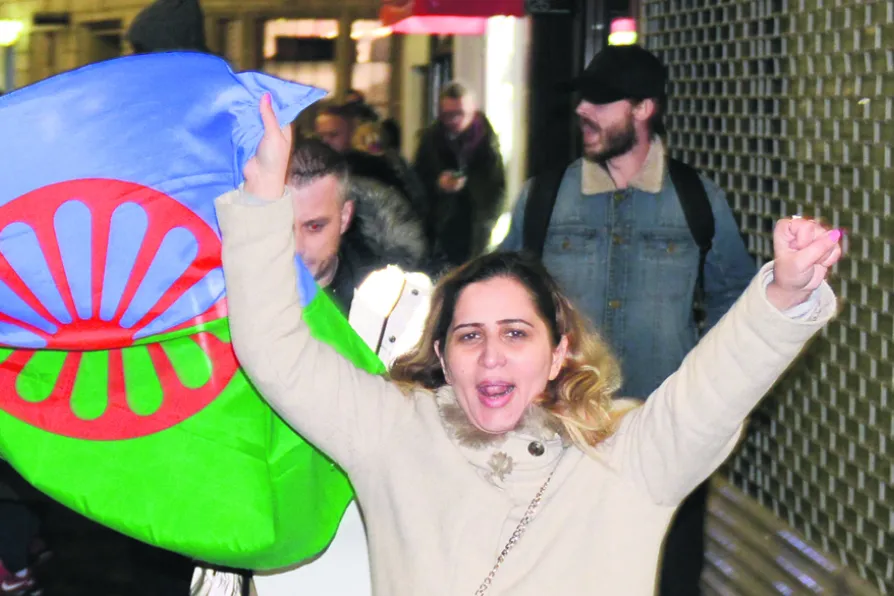 Daniela Abraham, organiser of the successful anti-fascist protest, marches in London holding the Roma flag
[Owen Liddle]
Daniela Abraham, organiser of the successful anti-fascist protest, marches in London holding the Roma flag
[Owen Liddle]

Once the bustling heart of Christian pilgrimage, Bethlehem now faces shuttered hotels, empty streets and a shrinking Christian community, while Israel’s assault on Gaza and the tightening grip of occupation destroy hopes of peace at the birthplace of Christ, writes Father GEOFF BOTTOMS
From a lockdown digital project to a vital tool for class solidarity, ROBERT POOLE and HENRY FOWLER reflect on half-a-decade of struggle
After years hidden away, Oldham’s memorial to six local volunteers who died fighting fascism in the Spanish civil war has been restored to public view, marking both a victory for campaigners and a renewed tribute to the town’s proud International Brigade heritage, says ROB HARGREAVES
The June 2025 attacks on Iran have heightened the risk of a wider war, exposed the fiction of a rules-based international order and left ordinary Iranians trapped between external aggression and internal repression, says the Committee for Defence of Iranian People’s Rights
While pretending to seek peace, Europe is heading toward a collision course with Russia – using security guarantees, troop deployments, expropriation and censorship as tools, writes SEVIM DAGDELEN
A WWI hero, renowned ornithologist, medical doctor, trade union organiser and founder member of the Communist Party of Great Britain all rolled in one. MAT COWARD tells the story of a life so improbable it was once dismissed as fiction





WHEN Daniela Abraham was a little girl in Slovakia in the 1980s her mother asked her why she was spending so much time scrubbing herself in the bath tub. “Because they told me I was a dirty Gypsy,” she told her mother.
Daniela is Roma. Her persecution in Slovakia began even before primary school — at nursery level: tiny tots refusing to play with her, being bullied, being called a “cigany,” meaning thief, criminal, liar.
Today Abraham, 39, lives in London, where she recently organised the first-ever collective Roma protest against Slovakian neonazis when they visited the capital to try to rally Slovakians living in Britain to their cause.
She uses her mother’s maiden name, rather than her family name, because she still has relatives living in Slovakia, where the rise of the far right is leading to even worse persecution of Roma than existed during her childhood.
In Britain she is also involved in the Sinti Roma Holocaust Memorial Trust. At least 750,000 Roma and Sinti people died in the Holocaust. More recent research says the number is more likely to have been twice that. Much of the slaughter took place after the nazis invaded Hungary in 1944. Members of Abraham’s family were among the victims.
Today’s rising Slovakian neonazis — the LSNS, the Our Slovakia Peoples Party — deny the Holocaust ever happened.
Abraham’s early story is one of thousands being repeated today in Slovakia and elsewhere in eastern Europe.
Her schooldays were not happy.
“From childhood it starts, almost from nursery. You get the bullies. You don’t understand why this is happening. The children don’t want to play with you. Calling you cigany. Being called that from when you are five or six years old affects your childhood.
“They call you ‘dirty Gypsy.’ They ask ‘why are you brown? You’re dirty.’ I remember as a child I would stay in the bath for hours trying to wash it off. My mother explained that I could not wash it off because this is our colour.
“I asked her ‘why am I this colour? I’m not dirty.’
“Even if I wore nice clothes, had a nice satchel, always they bullied me in school, didn’t want to play with me. I felt I wasn’t part of the collective.”
The teachers were no better. She continually found herself being given low grades despite her excellent work.
“I thought, ‘why are they doing this to me?’ Now I know. They were being racist. There was nothing wrong with me. It was what was wrong with them.”
One of the worst incidents happened when she was 10. She was walking home with her little brother when a neighbour shot her in the chest with a birdgun — a shotgun.
The day before he had shouted at her: “I’ll shoot you, you dirty Gypsy.”
“I still have the marks,” she said. “For months I was scared to go out.
The persecution continued into adulthood.
“In Slovakia I had massive difficulties finding a job,” she said. I speak several languages but it was very difficult for me to find work and support the family because of racism. Slovakia is so racist.
“This is why I was worried for my family, my children. I thought ‘I don’t want to give them this kind of life, this whole struggle.’ That’s why I came to the UK.”
Her husband — now her ex-husband — came to Britain, and she followed in 2007 with their sons. In Britain she became involved in the Sinti Roma Holocaust Memorial Trust.
“It was because my family was murdered. I don’t know exactly how many because my family was large.”
She lives in east London, doing a variety of jobs, including on a community project. Among the languages she speaks are Hungarian, Slovakian, Czech, German, Romanian and English.
A short time ago she discovered on Facebook that Slovakian neonazi LSNS organisers were coming to London to spread their hate among the capital’s Slovakian community. The visit was to involve a Euro-MP and a national MP from the neonazi LSNS.
“They openly made an event saying they were going to come here with their political campaign and have discussions at a meeting at the Barbican,” she said.
“I thought, ‘why come here, to a country that is multicultural? Why are you coming here? For what?’ It gave me a big question mark.

Similar stories
LYNNE WALSH reports from the Morning Star’s Race, Sex and Class Liberation conference last weekend, which discussed the dangers of incipient fascism and the spiralling drive to war
It’s where she was looked after and loved by workers who don’t deserve Starmer’s ugly condemnation, writes LINDA PENTZ GUNTER
From the struggle against the destruction of affordable housing to the fight for decent jobs, victory for Gypsy, Romani and Traveller people strengthens the whole working class, writes VICTORIA HOLMES
Political manipulation of history and exceptionalising of anti-semitism as a shield for Israeli war crimes are having a harmful effect on the fight against all racism and fuelling a cynicism that’s especially dangerous in today’s world, argue JULIA BARD and DAVID ROSENBERG